VII — Where Does Driving End and Society Begin?

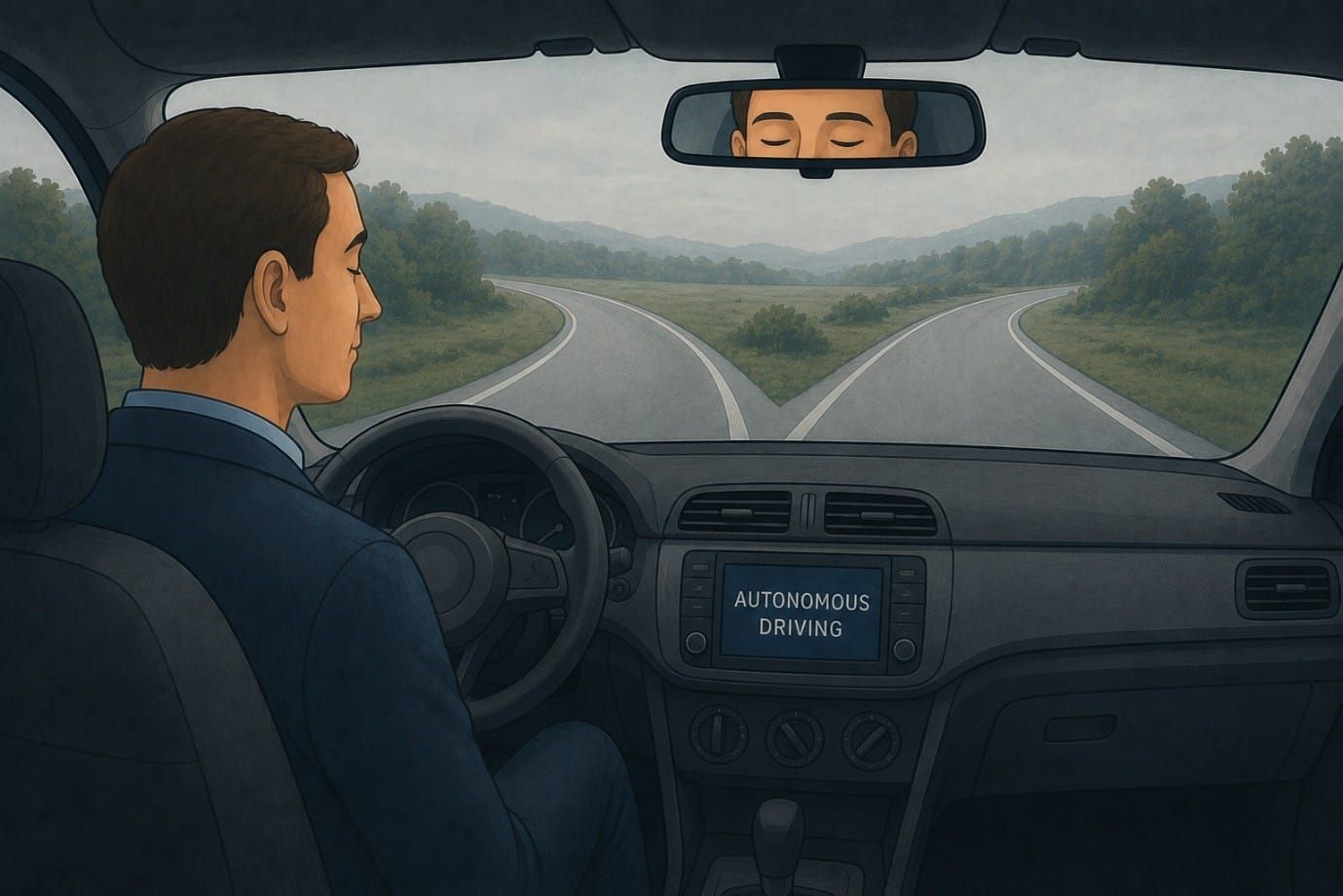
Series: Road Without Signs — On the Psychology of Movement in a World Increasingly Governed by Others
There are mistakes after which we immediately know who is responsible.
The driver braked too late.
Someone crossed the center line.
Someone looked at their phone instead of the road.
For decades, responsibility was tied to a human being.
To their attention, judgment, temperament, fear, or impulse.
But what happens when a mistake no longer has a clear face?
When the vehicle itself decides on speed, distance, and the moment of reaction.
When the system evaluates risk faster than a human being.
And when, despite all of that, it still makes a mistake.
That is the moment when the question stops being about traffic.
And becomes social.
Progress Faster Than Answers
Technology moves faster than law.
It always has.
Society creates a tool first, and only later tries to understand the consequences of its use.
That is how social networks emerged before we understood their influence on attention.
That is how algorithms shaping information appeared before we asked who controls the criteria behind those choices.
The same is now happening with autonomous driving.
Vehicles are being trained to react within milliseconds, while legal systems still think in the language of a world where humans alone held the steering wheel.
🔗 https://www.sciencedirect.com/science/article/pii/S2590198224000198
Sometimes it feels as if technology no longer waits for society to be ready.
It simply keeps moving forward.
Who Is Responsible When the System Fails?
If an autonomous vehicle causes an accident, who made the mistake?
The person sitting inside the vehicle?
The company that built the system?
The engineer who wrote the code?
Or the algorithm that “evaluated” the situation?
For decades, we have been used to responsibility having a name and a surname.
But systems based on machine learning function differently: sometimes even the programmers themselves cannot fully explain why an algorithm made a certain decision.
🔗 https://www.sciencedirect.com/science/article/pii/S1532046420302835
And this is where a new kind of unease appears.
Not because machines make mistakes —
but because we no longer know where the mistake ends and responsibility begins.
Should Programmers Take an Oath?
Doctors take the Hippocratic Oath.
Bridge engineers sign their projects with their own names.
But what about the people writing code that may one day make decisions instead of humans?
Decisions about braking.
About risk.
About whom the system “protects” in a fraction of a second.
In recent years, discussions about software engineering ethics and professional responsibility in AI development have become increasingly common.
🔗 https://www.acm.org/code-of-ethics
Perhaps the problem is not that machines are becoming more intelligent.
Perhaps the problem is that society still hasn’t decided how much moral and legal responsibility it is willing to transfer to the people creating them.
The Right to Control
For centuries, human has associated control with freedom.
Holding the steering wheel meant making decisions.
Sometimes wrong — but still our own.
Autonomous systems offer something else: comfort without effort.
Less stress.
Fewer decisions.
Less risk.
But every time a system decides instead of us, a quiet question emerges:
Are we still driving — or merely present?
Research shows that people in highly automated systems gradually lose their sense of active involvement and their ability to quickly take over control.
🔗 https://www.sciencedirect.com/science/article/abs/pii/S0968090X13000387
Perhaps the greatest change will not be technical.
Perhaps it will be psychological.
Getting used to a world that feels increasingly comfortable — and increasingly less ours.
The Mirror of Society
Autonomous vehicles are not just a new technology.
They are a mirror of how society understands power, control, and responsibility.
Because when systems begin making decisions, humans gradually stop asking:
“Is this right?”
And increasingly begin asking:
“Is this efficient?”
And perhaps the greatest crossroads of the modern world lies exactly there.
Not between man and machine.
But between comfort and awareness.
The Road Continues
But perhaps the real question is no longer who drives the vehicle.
Perhaps the question is — who drives us, once everything begins moving on its own.
When navigation chooses the route.
When the algorithm evaluates risk.
When the system decides what is safe, efficient, and desirable.
At that point, we are no longer speaking only about technology.
We are speaking about a world in which movement gradually separates itself from human will.
In the next essay of The Road Without Signs, we enter a space where autonomous mobility becomes more than technological progress — it becomes a new social order.
Perhaps the greatest paradox of the future is not that machines will think more and more.
But that humans, step by step, will need to decide less and less.
Will humanity use new technologies to make fewer decisions in technical spheres — and more in higher realms of thought?
Will modern technologies lead humanity toward spiritual decline — or spiritual awakening?
And precisely there, on the border between comfort and freedom,
The Road Without Signs reaches what may be its greatest crossroads yet.